Why Manufacturers Need to Rethink Industrial Laser Marking
Imgine your most experienced operator is out sick on Monday. The laser itself works perfectly, but nobody else is sure which marking template belongs to which variant, how the serial numbers are structured, or what has to be documented after each job. Suddenly, a four-second marking step is waiting on minutes of manual preparation.
Why a data matrix code alone doesn’t create traceability
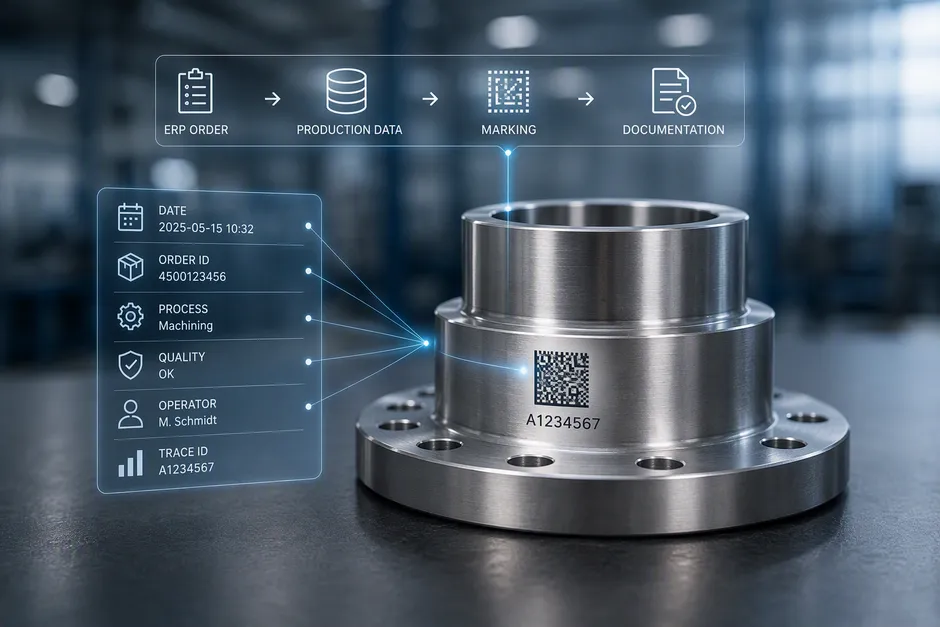
Many manufacturers focus first on code quality and readability, and rightly so. A Data Matrix code is a compact two-dimensional code that can hold a serial number or other identifier directly on the part. But a readable code alone doesn’t deliver digital traceability.
What counts is whether the underlying production data is complete, accurate, and available when you need it. The marked code becomes the connection between the physical component and its production record. Even a perfectly marked code loses its value if that record is incomplete, outdated, or incorrect.
In other words, the quality of the data matters as much as the quality of the mark. That’s why more manufacturers now treat marking as part of a larger workflow, where production data is generated where it originates and flows automatically through the process. The less data you transfer by hand, the lower the risk of errors and disruptions.
Read more about: The Importance of Traceability in Manufacturing
Where time really gets lost: Job preparation, serial numbers and documentation
The marking itself often takes only a few seconds. The time goes into everything around it: preparing jobs, importing data from your ERP (enterprise resource planning) system, selecting the right product variant, managing serial numbers, and documenting results.
Every manual step also adds a chance for error. A mistyped serial number or a wrong variant selection can break the link between a part and its data.
| Process step | Manual workflow | Integrated workflow |
|---|---|---|
| Job preparation | Operators verify orders and set up each job by hand | Production orders transfer automatically from the ERP system |
| Variant selection | Relies on the operator knowing which template fits which variant | Template and variant follow the order data |
| Serial numbers | Entered or tracked manually | Pulled from connected systems or generated by software rules |
| Documentation | Recorded by hand after marking | Production data documented end to end |
| Error risk | Grows with every manual step | Shrinks as manual entry disappears |
| Training new operators | Depends on knowledge in people’s heads | Follows a standardized, defined process |
How laser marking software connects ERP data to the part
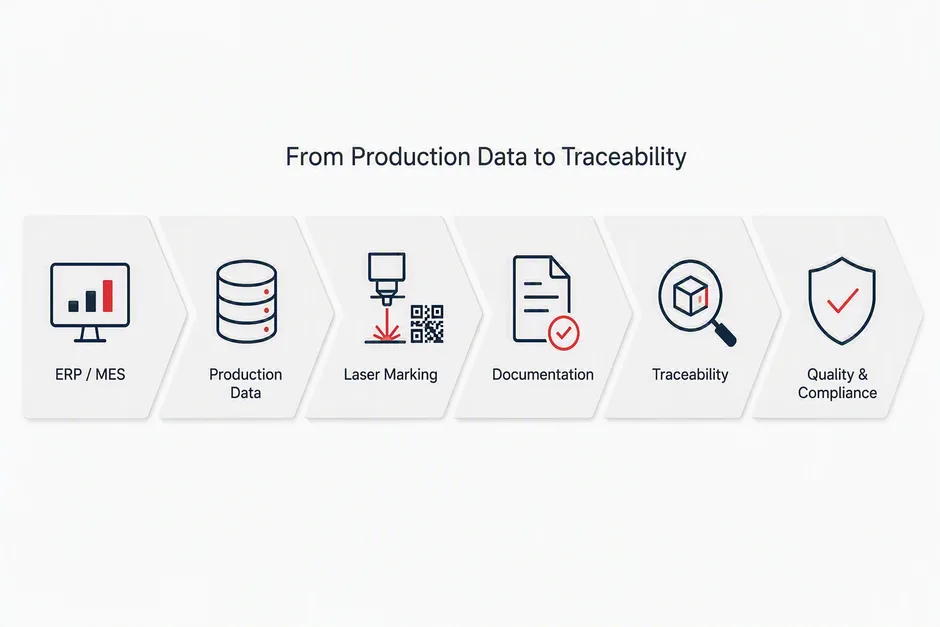
The goal is simple: generate production data where it originates, and make it available to the marking process automatically. Instead of retyping order details at the machine, the laser marking system receives them from your business systems.
Connecting marking to production data typically means:
- Automatic transfer of production orders
- Less manual data entry
- End-to-end documentation of production data
- Support for traceability requirements
- Easier scaling as production grows
Laser marking software with open interfaces makes this possible. Trotec’s Ruby® marking software, which controls, offers interfaces for external data and control commands. Its scripting options handle dynamic data such as serial numbers and codes directly in the software, without third-party programs.
The same approach scales with your volumes. SpeedMarker systems cover everything from small job-shop batches to production runs of up to 350 parts per hour, and their components are designed for 24/7 industrial use.
For a deeper look at how API-driven automation works in practice, read our guide to laser software automation. It explains how a REST-based API connects laser software with business and production systems.
Marking metal parts? Fiber lasers are widely used for permanent Data Matrix codes on metal. Browse our fiber laser marker machines to compare options. Marking is evolving from an isolated manufacturing step into a link between production data and the physical product.