Harnessing the synergy of laser cutting and UV printing
Crafting an alluring promotional display
Combining UV printing with laser cutting creates an efficient workflow for producing high-quality custom products, signage, and displays with exceptional precision and visual impact. UV printers deliver vibrant, durable graphics across a wide range of materials, while laser cutters provide clean edges and accurate contour cutting for intricate designs. Together, these technologies streamline production, reduce manual handling, and improve repeatability for both short-run and high-volume jobs. As demand for customised products continues to grow, integrating print and cut processes helps businesses maintain quality while increasing efficiency and turnaround speed.

Combining laser cutting and UV printing for high‑quality custom products
Laser cutting and UV printing have become a dependable combination for producing high-quality custom products, signage, and displays. UV printers cure ink instantly, creating vibrant color, sharp detail, and a durable surface across many materials. The Speedy laser cutter complements this by delivering high precision cutting and clean edges, even on intricate shapes. Together, they form a seamless Print&Cut workflow that delivers premium results with fast turnaround times.
This workflow has become especially important as many producers face rising order volumes, labor shortages, and increasing pressure to reduce manual steps. An integrated print and cut process is becoming essential for maintaining efficiency and throughput.
Why laser cutting and UV printing work so well together
UV printers provide high resolution graphics with excellent durability, while laser cutters ensure accurate contour cutting and polished edges. The two technologies reinforce each other, enhancing production efficiency and maintaining repeatable accuracy, making the workflow ideal for short run, customised, or on demand manufacturing.
Learn more about the Print&Cut workflow
Understanding the laser cutting process
The Print‑and‑Cut workflow is designed to keep production smooth, accurate, and repeatable. With Ruby® laser software and the Vision Print&Cut system working together, the entire process stays organised from data preparation to the final contour cut.
1.Prepare the artwork
In Ruby®, the design file includes printed graphics, vector cut lines, and registration marks.
2. Load the printed sheet
The Vision Print&Cut camera reads the registration marks and identifies their exact position on the material.
3. Automatic alignment
Ruby® adjusts the cutting path to match the printed image, correcting rotation, scaling, or slight distortion.
4. Contour cutting and repeat jobs
The laser follows the vector lines with high precision, producing clean edges without manual trimming. Once a job is set up, it can be repeated with a single click to keep cycle times short and throughput high.
Vision Print&Cut camera: key features
The Vision Print&Cut is a camera on the working head of the laser, which reads the printed registration marks printed on the material. The camera detects distortions in the print and aligns the cutting path with exceptional accuracy.
Fast and simple registration
Operators only need to align one printed registration mark on the screen. Once the first mark is aligned, the camera automatically reads the remaining marks at the start of the job, significantly reducing setup time.
Reduced material waste
Even if the printed sheet is rotated or shifted, the system automatically compensates for the offset and adjusts the cutting path. This minimises cutting errors and helps reduce material loss.
Compatible with multiple Speedy models
Vision Print&Cut can be installed on most Speedy models.. It can also be added after installation, giving existing users the flexibility to upgrade their workflow at any time
Ideal laserable materials for UV Printing and laser cutting
Acrylic and wood remain two of the most popular materials for Print&Cut workflows. Their physical properties make them perfect for both UV printing and laser processing.
Acrylic for UV Printing and laser cutting
Acrylic is one of the most versatile materials for Print&Cut applications. When processed with a laser, it produces glass‑like, polished edges that give finished pieces a premium, professional appearance. Its smooth, non‑porous surface pairs exceptionally well with UV printers, allowing them to deliver high‑resolution, vibrant color printing with excellent durability. Because acrylic performs so well with both laser cutting and UV printing, it has become a preferred material for signage, POP displays, awards, nameplates, and branded décor.
Wood for UV Printing and laser cutting
Wood offers a warm, natural texture that pairs beautifully with UV printing. The grain absorbs UV ink effectively, resulting in rich, natural looking color. Laser cutting ensures sharp edges and fine detail without chipping, making wood a strong choice for interior décor, signage, toys, and branded gift items.
Trolase: laserable plastics designed for Print & Cut
Trotec's TroLase range of laserable plastics is also a strong choice for UV printing combined with laser cutting. This advanced material offers excellent ink adhesion and is fully UV-stable, making it suitable for both indoor and outdoor applications. Available in a wide variety of colours, finishes, thicknesses, and durability levels, it enables the creation of high-impact designs such as signage, decorative panels, POS displays, and badges.
How UV printing and laser cutting elevate the Signage and Display industry
Modern signage often requires more than flat rectangular panels. Brands are looking for contour‑cut logos, dimensional lettering, layered acrylic signs, and displays that combine materials like wood, films, and composites. UV printing paired with laser cutting makes these designs easy to produce. UV printing delivers vivid, durable graphics on each substrate, while the Speedy laser cutter shapes every component with the precision needed for clean edges, tight fits, and detailed cut‑outs. This combination gives creators the flexibility to build more engaging, visually dynamic signage without adding complexity to their workflow. This flexibility also applies to POP displays, awards, packaging prototypes, and other custom products.


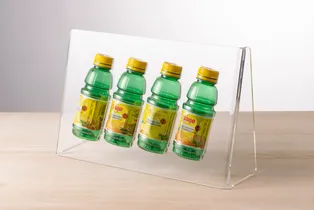
Top 5 most popular materials for Print‑Cut projects
1. Acrylic (PMMA) — Clear, colored, or frosted; ideal for signage, displays, and awards.
2. Wood (plywood, MDF, hardwood) — Great for décor, packaging, and branded merchandise.
3. Cardboard & Paperboard — Used for packaging prototypes, POP displays, and model making.
4. PET / Polyester Films — Suitable for stencils, labels, and backlit signage.
5. Foamboard / Composite Panels — Lightweight and perfect for exhibition graphics and retail displays.