Diode Lasers: The Guide to Precision Marking, Engraving and Cutting
This complete guide covers the fundamentals of diode laser technology, their practical capabilities and limitations, and how to determine if a diode laser is the right choice for your specific application.
Diode Lasers – in a nutshell
- Definition: A diode laser uses a semiconductor diode to generate the laser beam when electricity is applied, which then typically emits blue light.
- Key Strengths: Compact design, energy efficiency and high precision
- Applications: Precise surface engraving, cutting of thin materials and high contrast marking on various materials
- Advantages: Compact design, energy efficiency, long lifespan
- Limitations: No processing of clear acrylic or clear glass as well as cutting thick materials
What is a diode laser and how does it work?
Diode lasers use a small electronic component (semiconductor diode) to generate the laser beam when electricity is applied. The laser then emits the laser beam in a blue light wavelength, which is very energy efficient. They have evolved significantly from their early reputation as hobby-grade tools to industrial usage. Today's industrial diode lasers deliver professional-grade precision for marking, engraving, and cutting applications across manufacturing and creative industries.
Diode lasers produce light using semiconductor materials. In the Speedy 100 cross system, eight single-emitter laser diodes with ~5,5 W each are combined to create a powerful 40Watt beam. This is done using knife-edging of 4 emitters (in a line) and a polarization beam combiner which combines the 2 branches of 4 emitters each, The polarization beam combiner merges beams with perpendicular polarizations into one unified output.
The result? A compact, highly efficient laser source with excellent beam quality and low divergence. The emitted light has a wavelength of 450 nm—right in the visible blue spectrum. This shorter wavelength plays a key role in how diode lasers interact with different materials.
What can a diode laser do?
Diode lasers excel at processing organic materials and creating permanent markings on industrial components:
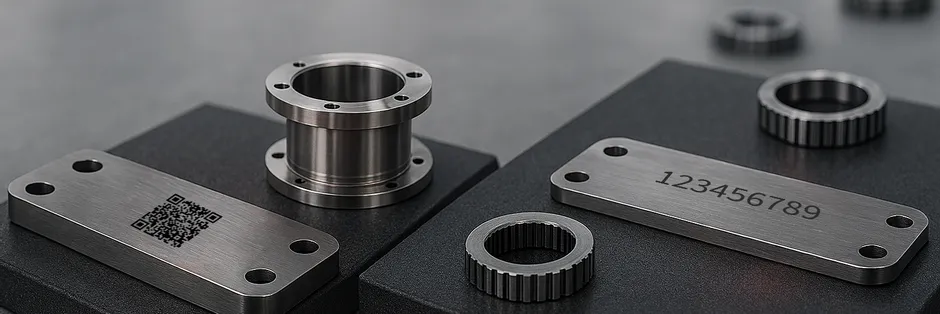
- Industrial marking: Diode lasers are perfect for marking metals, plastics, as well as circuit boards (PCBs) with high-resolution QR codes, serial numbers for product traceability or other details.
- Cutting thin materials: A diode laser can be used for cutting as well as marking, but is limited to thin materials like plywood, paper and cardboard. Due to the blue light wavelength diode lasers cannot cut clear or transparent acrylic, clear glass or thick materials like stone, ceramic and metals.
- High contrast engraving: Engraving materials with a high contrast works very well with a diode laser. Materials like dark acrylics, leather, wood and cork can easily be engraved with brandings, personalized and more.
How do diode lasers compare to CO2 Lasers?
When choosing a laser system, you will encounter various technologies, where choosing the right one for your use case can be overwhelming. The fundamental difference between diode lasers and CO2 lasers lies in the light source:
Photochemical vs. thermal interaction
Unlike CO₂ lasers, which rely ONLY on heat to process materials, diode lasers can trigger photochemical reactions. These reactions happen when photons break chemical bonds without significantly heating the material. The outcome is clean, high-contrast markings with very little debris and no heat affected zone Think of it like skin tanning—caused ONLY by UV light (and NOT by heat). Similarly, diode lasers can mark plastics and organic materials (including the solder resist layer of a printed circuit board) without burning or melting them, making them ideal for delicate applications.
Diode laser:
- Light source: A semiconductor diode is used which creates a blue light laser
- Power output: Lower than CO2 lasers, but therefore ideal for precision tasks
- Best applications: Traceability for marketing, personalization and engraving
- Investment: Lower initial cost and very energy-efficient during usage
CO2 laser:
- Light source: CO2 lasers use a gas-filled tube which creates the laser beam
- Power output: Higher than a diode laser
- Best applications: Cutting thick materials, processing clear glass and acrylics
- Investment: Higher initial cost and higher power consumption
For businesses focused on precise marking, personalization, and industrial traceability with small to medium throughput, diode lasers offer a practical balance of cost-effectiveness and reliability. Industrial-grade machines like the Speedy 100 cross demonstrate these capabilities with professional-grade results.
Why some materials work and others don’t
Whether a material is compatible with a diode laser depends on how well it absorbs 450 nm light. If the material is transparent to this wavelength, the laser simply passes through without any effect.
Materials that work well include:
- Metals (e.g. ALL steels including stainless steels)
- Many plastics
- 2-ply plastics with black core
- Wood, paper, leather, etc.
Materials that don’t work:
- Transparent acrylic (PMMA)Non-colored glass
Materials that don’t work well:
- 2-ply plastics with white core
These materials don’t absorb blue light effectively, so they’re better suited for CO₂ laser processing.
For a detailed list of compatible materials, check out Shop materials
Why are Diode Lasers a good long-term investment?
High-quality diode lasers (like the ones provided by Trotec) offer exceptional operational lifespans, typically rated between 25000 and 50000 hours, with potential to exceed 100000 hours under optimal conditions.
To maximize lifespan and protect your investment, industrial-grade machines incorporate several key features:
- Thermal Management: Operating at recommended temperatures extends component life significantly
- Environmental Protection: Technologies like Trotec's InPack Technology™ shield sensitive optical and mechanical components from dust and debris, ensuring consistent performance in production environments
- Low Maintenance Requirements: Diode systems require significantly less maintenance than gas-based alternatives
- Efficiency: >40% electrical efficiency (laser power out divided by DC power in) compared to ~8% for CO₂ lasers. This reduces operating costs and makes the actively RPM-controlled air-cooling VERY quiet – at least 10 dB(A) less compared to an equally powered air-cooled CO2 laser.
What materials can't diode lasers mark, cut or engrave?
Due to the blue light’s wavelength, diode lasers are limited in their usage:
- Transparent materials: Materials like clear glass or clear acrylic are challenging for diode lasers. The wavelength of diode lasers is not readily absorbed by transparent materials, leading to poor or no engraving/cutting results.
- Thick materials: While excellent for marking metals and other thick materials, diode lasers cannot cut these materials.
What are essential safety precautions for diode lasers?
Eye protection is essential for all laser operations, particularly with visible light lasers like blue diode lasers. Therefore, always use specialized safety glasses designed to block your specific diode laser's wavelength. Never operate the machine without appropriate eye protection. Speedy laser systems, when properly operated with the lid closed, are Class 2 laser systems and include integrated eye protection within the safety lid. The different lid colors are specifically engineered to provide protection from the various laser sources used in the system, helping ensure safe operation when used as intended.
Conclusion: When a diode laser makes sense
Modern industrial diode lasers have matured into precision tools suitable for demanding production environments. They are particularly well-suited for applications requiring:
- High-precision industrial parts marking
- Product serialization and QR code traceability
- Personalization and customization services
For operations centered on these applications, an industrial diode laser like the 40-watt Speedy 100 cross—with its large working area and Ruby® software integration—provides a practical combination of precision, reliability, and operational efficiency.