Laser Software Automation: How Ruby Takes You from Manual to API
As production environments become more connected, the role of laser workflow automation is shifting from “nice to have” to a critical competitive factor - especially for manufacturers building integrated production systems.
With Ruby laser software, companies can move beyond manual job handling and step into API‑driven laser production, where lasers become part of a fully automated, scalable workflow.
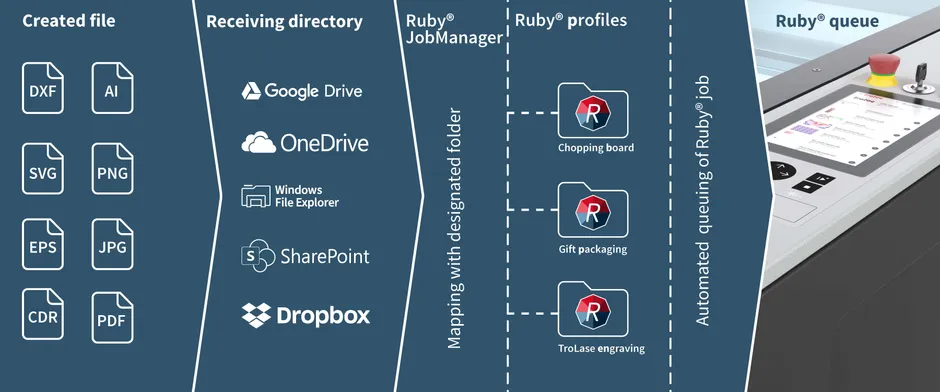
What is laser software automation – and why does it matter?
Laser software automation means removing manual steps in job preparation, execution, and data handling, and replacing them with connected, rule-based or API-driven processes.
In traditional setups, operators:
- Prepare files manually
- Select parameters manually
- Assign jobs to machines manually
- Re-entering job data into ERP or reporting systems
This creates real problems at scale: process variability, operator-dependent quality, slow job turnover, and no reliable data trail.
With laser job automation software, these steps are:
- Automated at the source (e.g., ERP, MES, webshop)
- Standardized through profiles and rules
- Executed consistently across machines
For industrial production, this is crucial: automation ensures reliable, repeatable processes, reduces scrap, and enables end-to-end traceability - all essential in industrial environments.
Also read: Why is Ruby® laser software the best for educational institutions?
The 3 levels of automation in Ruby laser software
1. Basic automation
At the first level, Ruby uses predefined profiles and rule-based workflows:
- Standardized laser material parameters
- Repeatable job preparation
- Minimal operator decision-making
This is ideal for stable, repetitive processes but limited when workflows become dynamic.
2. Advanced workflow automation with Node-RED
Ruby integrates with Node-RED — a visual, flow-based programming tool that connects hardware inputs, databases, APIs, and services without requiring custom code development.
- Connect scanners, PLCs, and databases
- Automate job routing and triggering
- Build dashboards and simplified operator interfaces
This level introduces event-driven workflows and reduces operator touchpoints, but it remains focused on orchestration rather than deep system integration.
3. API based automation
This is where Ruby laser software becomes truly industrial.
With the Ruby API, manufacturers gain:
- Full programmatic control of job creation and processing
- Integration into ERP, MES, SQL, or custom systems
- Automated, parameter-safe workflows
- Multi-machine routing and load balancing
This level enables API‑driven laser production, where the laser is no longer a standalone tool but a fully integrated production component.
Learn more about Trotec's Industry Solutions
The Ruby automation API is a REST-based interface that connects laser software directly with business and production systems.
In practice, this means:
1. Automated job creation
Incoming data (orders, serial numbers, personalization info) automatically generates laser jobs - eliminating manual setup and reducing job launch time to seconds.
2. Standardized processing
Predefined profiles ensure correct parameters are applied every time, reducing variability and errors.
3. Intelligent job routing
Jobs are automatically assigned to the right machine based on availability or workload.
4. Real-time feedback
Machine and job status are continuously sent back to ERP or MES systems for monitoring and planning.
5. Scalable production logic
From small batches to high-volume production, workflows scale without increasing operator workload.
For equipment manufacturers, this enables:
- Seamless integration into production lines
- Event-driven automation (e.g., PLC signals, robotics)
- Serialization and traceability
- Stable, repeatable output
In short: the API transforms a laser into a data-driven production asset.
Manual vs Automated laser jobs workflow
Production step | Manual Process | With Ruby Laser Software |
Job preparation | Operator configures parameters manually | Auto-applied via saved profiles |
File assignment | Operator selects and loads files | Triggered from ERP/database automatically |
Machine routing | Assigned by operator judgment | Intelligent routing based on availability |
Quality consistency | Varies by operator and shift | Identical parameters every run |
ERP/MES sync | Manual data entry after the fact | Real-time API feedback, continuous sync |
Traceability | Paper logs or manual records | Full digital audit trail per job |
Throughput scaling | Requires more operators | Scales with capacity, not headcount |
Is Ruby laser automation right for your production?
API-driven automation is particularly relevant for manufacturers and system integrators when:
- The laser must be embedded into automated production cells
- Production requires ERP/MES integration
- There is a need for traceability and serialized workflows
- Manual interaction must be minimized
- Multiple machines must operate as a coordinated system
In these environments, automation delivers:
- Higher throughput
- Reduced operator dependency
- Consistent quality
- Reliable industrial processes
For personalization or small batch workflows simpler approaches (profiles or Node‑RED) can already deliver strong efficiency gains.
From manual to automated – A practical adoption plan
Moving to laser workflow automation doesn’t require a complete system overhaul. A phased approach works best:
Step 1: Standardize
Start with predefined profiles and rule-based workflows to ensure consistency.
Step 2: Automate workflows
Introduce Node‑RED to connect systems, automate triggers, and reduce manual steps.
Step 3: Integrate via API
Implement the Ruby API to:
- Automate laser jobs directly from business systems
- Enable full API‑driven laser production
- Scale across machines and production lines
Step 4: Expand and optimize
Add dashboards, monitoring, and analytics for continuous improvement.
Conclusion
With Ruby laser software, automation evolves from simple operator support to fully integrated, API-driven production.
For equipment manufacturers, this is a strategic advantage:
- The laser becomes part of a connected production ecosystem
- Workflows become predictable, scalable, and data-driven
- Automation enables growth without increasing complexity – by systematically improving throughput, machine utilization, process stability, and lead times while reducing manual intervention.
By adopting laser job automation software step by step, companies can move confidently from manual processes to a future-ready, automated production environment.