Managing Job Distribution Across Multiple Laser Systems
In many production environments, increasing output is not primarily a question of machine speed. It is often a question of coordination.
Consider a business that operates several laser systems. Orders arrive throughout the day, some consisting of unique jobs, others requiring hundreds of identical parts. When production capacity needs to be distributed across multiple machines, operators are often faced with a series of small administrative tasks: preparing files, opening device interfaces, assigning jobs to individual queues and monitoring machine availability.
Individually, these actions take only a few moments. Repeated dozens or hundreds of times each day, however, they become part of the production process.
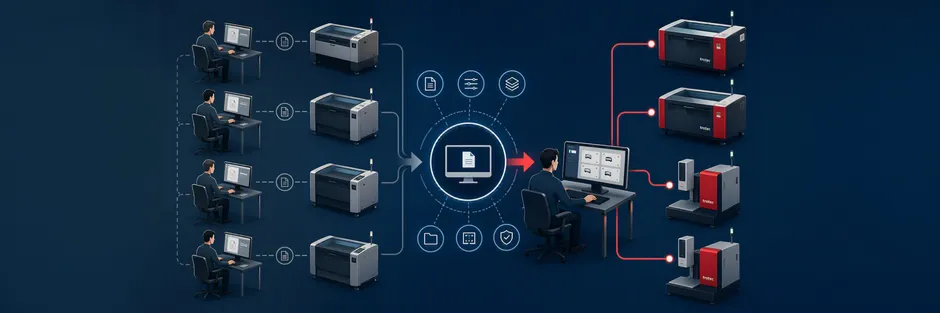
When production scales, coordination becomes important
A common example is a repeat order that has to be completed within a limited timeframe. The job itself is straightforward. The settings have already been tested and approved. The material is available. Several laser systems are ready to process the work. The challenge is no longer determining how to produce the parts. The challenge is distributing the workload efficiently. As production environments become more connected, this type of task becomes increasingly important. A workflow that works well on a single machine does not always scale smoothly across several devices.
Looking beyond laser machine performance
Discussions about productivity often focus on speed, acceleration or processing times. These factors are certainly relevant, but they represent only one part of the overall workflow.
Production performance is also influenced by:
- How quickly laser jobs can be prepared
- How consistently settings can be applied
- How efficiently work can be distributed across available machines
- How easily laser operators can access and manage production resources
For organizations operating multiple laser systems, workflow efficiency often has a direct impact on overall throughput.
Bringing device access and job distribution together
This is one area where software tools continue to evolve. A recent example is the introduction of the Ruby® Smart Add-on.
The Trotec Ruby® Smart Add-on extends Trotec Ruby® laser software into the browser environment and provides access to connected devices from a central location. Rather than moving between multiple browser windows or device interfaces, users can view available systems and interact with them through a single workspace.
For businesses operating several laser systems, central access can simplify day-to-day production management and reduce some of the repetitive administrative steps associated with job distribution.
Consistency matters as much as speed
Another challenge in professional production environments is maintaining consistency. Many organisations process similar jobs repeatedly. Whether producing industrial components, signage, educational projects or personalised products, operators often rely on established settings and repeatable workflows. For this reason, standardised job preparation becomes increasingly important as production volumes grow.
The Ruby® Smart Add-on supports the use of import profiles, allowing predefined settings to be applied when files enter the workflow. Users can find detailed setup instructions and feature documentation in the Help Center. This helps maintain consistency across devices and operators while reducing manual configuration work. The objective is not necessarily to make individual jobs faster. The objective is to create processes that remain predictable and manageable as production demands increase.
Supporting multi-device production
Multi-device production is becoming more common across many areas of laser processing. Production teams may distribute repeat jobs across several machines to increase capacity. Educational institutions may manage shared equipment used by multiple groups. Service providers may balance workloads between available systems throughout the day. In these environments, efficiency is often achieved through organisation and workflow design rather than through any single piece of equipment.
The ability to send jobs directly to one or multiple Ruby-connected devices is one example of how software developments are helping to support this type of workflow.
Small improvements, larger impact
Many operational improvements do not come from major process changes. They result from removing small, repetitive tasks that accumulate throughout the day. As organisations expand their production capabilities and connect more devices, the ability to manage workflows efficiently becomes increasingly relevant. Tools such as the Ruby® Smart Add-on reflect a broader shift within manufacturing and production environments: improving productivity not only through machine performance, but also through the way work is organised, distributed and managed.
The Ruby® Smart Add-on is available as a free browser extension for Google Chrome.