Laser education: What's the best laser machine for schools
Lasers have become an increasingly valuable tool in educational environments. Laser engraving and cutting machines support hands-on learning across subjects such as design technology, engineering, science and STEM-focused programs. Choosing the right laser cutter for schools is not simply a question of technical specifications or purchase price. The system needs to integrate safely, reliably and practically into a classroom, lab or makerspace setting.
CO₂ laser cutters, such as those developed by Trotec Laser, are commonly used in education because they provide a balanced combination of material versatility, precision and safety. When paired with the appropriate safety classification, intuitive operation and dependable support, a classroom laser cutter can become a long-term teaching tool rather than equipment restricted to specialist users or advanced courses.
What to look for in a laser cutter for schools
When evaluating a laser cutter for educational use, schools typically prioritize factors that directly affect safety, teaching continuity and long-term usability.
Safety
In school environments, safety requirements are fundamentally different from those in industrial settings. Laser systems in educational settings are often used by multiple users with varying levels of experience and must operate safely under normal classroom supervision.
Laser machines are classified from Laser Safety Class 1 through to Laser Safety Class 4. In education, fully enclosed Class 2 systems are typically used because laser radiation is not accessible during normal operation. These systems do not require specialized protective equipment, allowing students and teachers to work confidently while gaining practical experience with digital fabrication technologies.
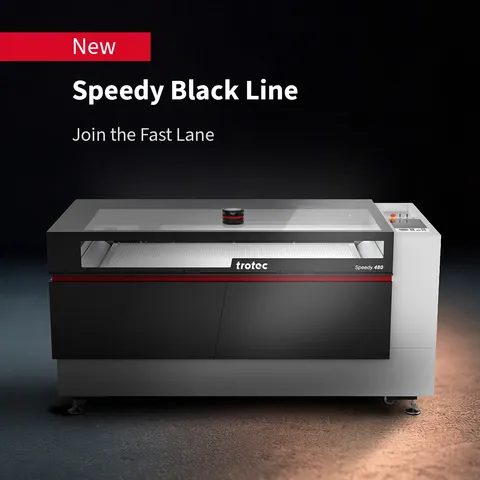
Class 2 systems, such as those in the Speedy series from Trotec Laser, incorporate enclosed working areas, interlocked doors and integrated safety monitoring. These design features support safe, repeatable use without relying solely on procedural controls or close supervision.
Effective exhaust and filtration systems are also essential in educational environments. Laser processing can produce fumes and particulate matter, particularly when working with materials such as wood and acrylic. Trotec Atmos extraction systems are designed to efficiently remove fumes and particles during laser processing and are compatible with Trotec lasers and many other laser brands commonly found in schools.
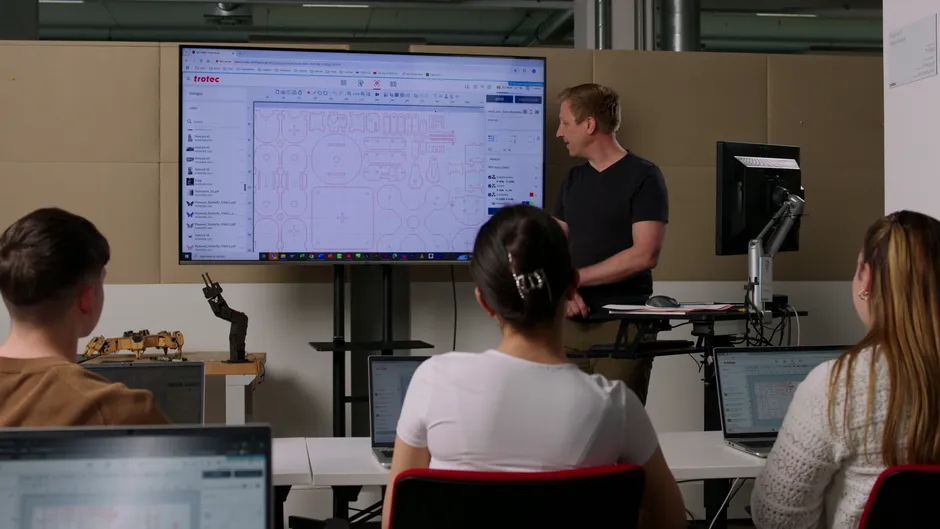
In addition, Ruby® laser software supports classroom safety by providing guided workflows and visual job previews. These features allow users to identify setup issues before laser processing begins, reducing the likelihood of errors during operation.
Ease of use
In education, laser technology must be approachable. Teachers and students need to focus on learning objectives and curriculum outcomes rather than technical complexity.
An effective classroom laser cutter simplifies machine setup, job preparation and operation, allowing productive use within limited lesson times. In practice, this reflects a common educational constraint: systems must function reliably within short teaching blocks and be usable by students with very different skill levels.
Ease of maintenance is also an important factor. In busy school environments, systems that require minimal routine upkeep and offer dependable service support are more likely to remain in regular use year after year. Straightforward maintenance tasks and reliable technical support help reduce unexpected downtime that could disrupt teaching schedules.
Ease of use is not determined by hardware alone. The software controlling the laser plays a significant role in how effectively the system can be integrated into everyday teaching.
Performance
In schools, laser performance is evaluated less by maximum throughput and more by consistency and predictability. Reliable, repeatable results support structured lesson planning and help ensure that projects can be completed within allocated teaching time.
CO₂ laser cutters are well suited to educational use because they can process materials commonly used in teaching environments, including wood, acrylic, cardboard, rubber and fabrics. Consistent laser output helps educators achieve predictable results across different classes and academic years, reducing failed jobs and material waste.
Cost and support
While budget considerations are always relevant in education, long-term value depends on more than the initial purchase price. Schools require systems that remain usable and supportable over many years.
Support in an educational context includes access to training resources, clear documentation and dependable technical assistance. These factors help institutions maintain continuity as staff, curricula and course requirements change over time.
Download our free eBook to read about how laser machines can prepare students for professional life.
Why Ruby® laser software matters in education
In shared educational environments, laser software directly affects safety, efficiency and teaching continuity. Machines are often used by different groups of students under time constraints, with limited opportunity for individual supervision.
Ruby® laser software is designed to support these conditions through structured, step-by-step workflows and clear visual job previews. These tools help users understand each stage of the process before starting the laser, reducing setup errors, material waste and unnecessary machine downtime.
For educators, Ruby® provides improved process visibility and control while allowing students to work more independently. This supports scalable use of laser technology across multiple classes, subjects and year levels without increasing supervision effort. Treating software as a core component of the laser system helps ensure that laser technology remains manageable and effective as part of everyday teaching.
Laser machines commonly used in educational environments
Many schools and universities use CO₂ laser systems from the Speedy series because they combine education-appropriate safety with professional laser performance. Fully enclosed Class 2 designs support safe operation under normal classroom supervision, while stable mechanics and consistent output support repeatable results across multiple classes.
Within this portfolio, Speedy 100 cross is particularly suited to educational environments where space, supervision requirements and material flexibility must be balanced. Its compact footprint allows easy integration into classrooms, labs and makerspaces, while its diode laser technology provides students with practical experience using an alternative laser process.
By working with systems based on the same technology principles used in professional environments, students gain exposure to workflows that reflect real-world manufacturing conditions.
A practical evaluation checklist for schools choosing a laser cutter
Safety and classroom suitability
- Is the laser designed for educational environments?
- Does it meet an appropriate laser safety classification, such as Class 2?
- Are safety features built into the machine?
- Is effective fume extraction or filtration available?
Ease of use
- Can teachers introduce the laser without extensive technical training?
- Is the workflow suitable for students with mixed experience levels?
- Does the laser support productive use within typical lesson times?
Teaching and curriculum alignment
- Does the laser support materials used across different subjects?
- Can it be used consistently across year levels?
- Does it encourage problem-solving and creative application?
Performance and reliability
- Are results accurate and repeatable across classes?
- Does the laser minimize failed jobs and material waste?
Software and workflow
- Does the software provide guided workflows and visual previews?
- Does it support safer student independence and effective teacher oversight?
Support and long-term value
- Are training resources and local technical support available?
- Will the laser remain usable as staff and curricula change?