How to Prevent Human Error in Laser Manufacturing and Improve Quality
In modern manufacturing environments, laser systems today achieve an exceptional level of precision and repeatability. Nevertheless, quality issues, rework, and production delays continue to occur. For many companies, these errors are particularly critical because they are often not detected until material, machine time, and labor have already been invested.
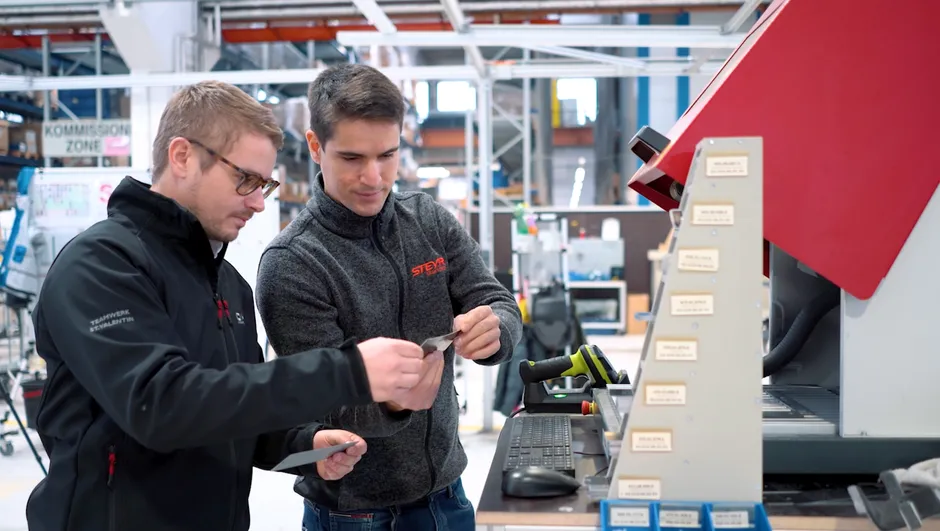
Common causes of human error in laser manufacturing
Most errors in laser manufacturing occur long before a workpiece is actually marked, engraved, or cut. Typical causes include: manually entered serial numbers, incorrect import data, wrong file versions, altered laser parameters, unclear work instructions, missing approvals, and data inconsistencies between different software solutions. While a single error often seems insignificant, the consequences can be significant.
Especially in regulated industries such as medical technology, electronics, or the automotive sector, even minor deviations can compromise traceability and lead to costly corrective actions.
The 5 most common sources of human error in laser manufacturing
Manual data entry
Variable data is among the most common applications of industrial laser marking today. This includes applications in the areas of direct part marking (DPM), serial number marking, and traceability (e.g., lot numbers, UDI markings, customer-specific information). If this data is transferred or edited manually, the risk of input errors increases significantly. A single transposed digit can be enough to compromise a product’s traceability.
Outdated production data
Many companies manage production files locally or across multiple systems simultaneously. This increases the risk that outdated layouts, incorrect product information, unapproved labels, or obsolete logos will make their way into production. Such errors often go unnoticed for a long time, especially with recurring orders.
Differing settings among employees
Experienced operators often develop their own procedures. What may seem helpful in the short term often leads to difficulties in the long term. The more knowledge is held exclusively by individual employees, the greater the risk of quality issues.
Incorrect positioning of components
Positioning errors can result in significant costs, particularly with high-quality components or workpieces that have already been machined. Examples include incorrectly placed markings, misaligned logos, incorrect engraving positions, or inaccurate labeling of functional parts. The value of the material itself often plays a secondary role. The actual costs arise from the value already invested in the part
Lack of process documentation
If it is not possible to trace which file was used, which employee performed the production, which settings were applied, or when changes were made, root cause analysis becomes difficult. Without transparency, errors often cannot be eliminated in the long term.
Also read: Laser Workflows Reduce Errors in Student and New Operator Training
Why preventing errors delivers greater results than additional quality inspections
Many companies respond to quality issues with additional checks. However, more inspections mean longer lead times, higher costs, more administrative work, and added complexity. Checks usually only detect errors after they have already occurred. A much more effective approach is one that eliminates sources of error in advance.
The shift from error detection to error prevention
Modern manufacturing companies are increasingly adopting the principle of error prevention. The goal is to design processes so that errors cannot occur in the first place. Four factors are particularly crucial for this:
- Standardization: Defined templates, processes, and settings reduce individual variations.
- Automation: Automatic data transfers prevent data entry errors and increase process reliability.
- Transparency: Clear responsibilities and traceable production steps facilitate quality management.
- Reproducibility: Every order should deliver identical results regardless of the operator.
The importance of traceability in modern manufacturing
In the context of Industry 4.0 strategies, digitally networked manufacturing, and rising quality requirements, traceability is becoming increasingly important. Today, companies often need to be able to track: what data was used, when production took place, which settings were active, what changes were made, which serial numbers were assigned, etc. Seamless traceability not only facilitates audits and quality documentation. It also enables significantly faster root cause analysis in the event of a defect.
Also read: Laser Engraving Productivity Starts Before the Laser Machine
How connected production processes reduce human error
Digital and connected production environments help companies prevent errors at their source. Among the key benefits of a smart factory are:
Automatic Data Integration
Production data can be imported directly from ERP systems, databases, or other enterprise systems.
Centralized data management
All stakeholders access the same approved information.
Protected processes
Approved material parameters and templates reduce the risk of unintended changes.
Traceable production history
Changes and production steps can be documented and traced.
Consistent results
Standardized processes ensure higher repeatability across shifts, locations, and employees.
Conclusion: Quality isn’t created by the machine alone
Most production errors do not occur during the laser cutting process. They arise in the processes leading up to it. By standardizing data flows, reducing manual intervention, and creating transparency, you can prevent errors in the long term. That’s why the most successful manufacturing companies don’t just focus on the performance of their laser machines. They invest in stable processes, reproducible workflows, and seamless traceability. That’s exactly why the Ruby® laser software was developed.